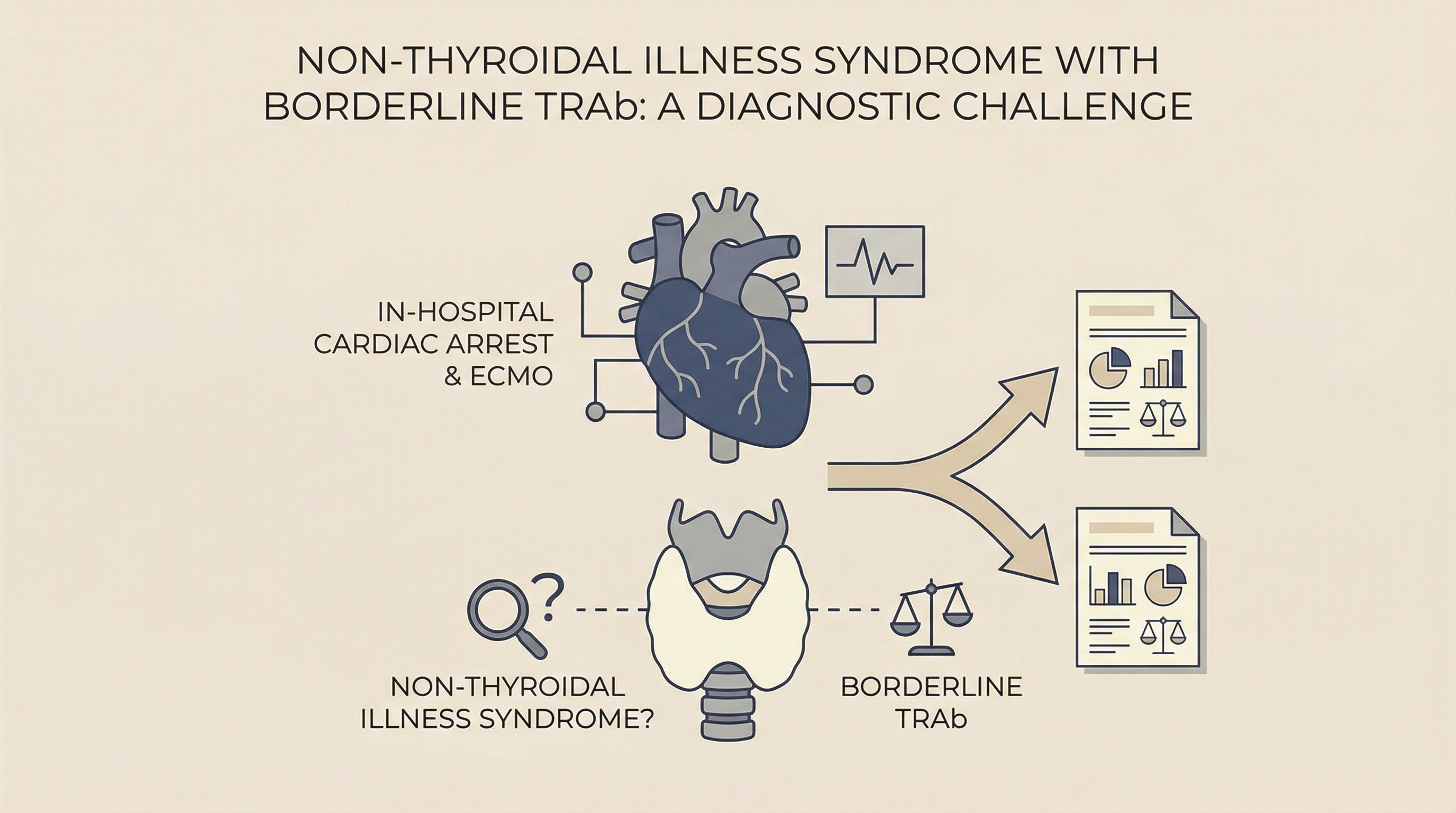
Non-Thyroidal Illness Syndrome with Borderline TRAb After In-Hospital Cardiac Arrest and ECMO Resuscitation: A Diagnostic Challenge
Abstract
Background: Non-thyroidal illness syndrome (NTIS) 是加護病房常見的甲狀腺功能異常,盛行率約 58-70%。然而,在 in-hospital cardiac arrest (IHCA) 接受 extracorporeal membrane oxygenation cardiopulmonary resuscitation (ECMO-CPR) 且同時暴露於 amiodarone、catecholamine 及 heparin 的成人患者中,甲狀腺功能檢查 (thyroid function tests, TFTs) 的判讀面臨多重干擾因素交織的挑戰。此類複雜情境下合併 borderline thyrotropin receptor antibody (TRAb) 陽性之個案,目前文獻尚無報導。
Case Presentation: 一名有 hypertension、dyslipidemia、type 2 diabetes mellitus 及 hypertensive intracerebral hemorrhage 病史之成年男性,因 infectious diarrhea 併發 hypovolemic shock 後發生 ventricular fibrillation 導致 IHCA,經 ECMO-CPR 急救後恢復循環。急救過程使用 amiodarone bolus、norepinephrine、epinephrine 及 continuous heparin。住院期間發現 TSH 0.099 μIU/mL(suppressed),但 free T4 1.15 ng/dL 及 free T3 2.72 pg/mL 均在正常範圍。進一步檢查顯示 TRAb 14%(borderline,cutoff 14%)、anti-TPO 7.06 IU/mL(mildly elevated,reference <5.61),thyroglobulin 及 Tg antibody 正常。經多專科團隊以系統性文獻回顧與 Bayesian framework 進行鑑別診斷,最終判斷為 NTIS 合併多重藥物效應所致之 TSH suppression(信心度 74.5%),TRAb borderline 最可能為 assay noise 或重症相關之非特異性反應。
Conclusions: 在 ECMO-CPR 後合併 catecholamine、amiodarone 及 heparin 使用的重症情境中,TFTs 判讀需考量多重干擾因素。Borderline TRAb 不應倉促診斷為 Graves' disease,建議採 watchful waiting 策略並於病情穩定後追蹤確認。
Keywords
Non-thyroidal illness syndrome, Euthyroid sick syndrome, ECMO, Amiodarone, TRAb, Thyroid function tests, Critical illness, Cardiac arrest
1. Introduction
Non-thyroidal illness syndrome (NTIS) 是重症患者中最常見的甲狀腺功能異常,一項納入 25 篇研究、6869 名患者的系統性回顧與統合分析顯示,其在 ICU 的盛行率中位數為 58%,且與死亡率獨立相關(OR 2.21, 95% CI 1.64-2.97)[1]。NTIS 的典型表現為 low T3、elevated reverse T3 (rT3)、normal 或 low TSH,在重症 acute phase 伴隨 cytokine storm 及 NF-κB 活化時,可出現更為複雜之 hormone profile [2]。
在 ICU 環境中,多種常用藥物會進一步干擾 hypothalamic-pituitary-thyroid (HPT) axis:catecholamine(norepinephrine、epinephrine)透過 dopaminergic 機轉抑制 TSH 分泌 [3];amiodarone 因含 37% iodine 且其代謝物 desethylamiodarone (DEA) 抑制 type I 5'-deiodinase (D1),可導致 amiodarone-induced thyroid dysfunction (AITD) [4];heparin 則透過活化 lipoprotein lipase 釋放 free fatty acids (FFA),造成 in vitro FT4 assay interference [5]。
Cardiac arrest 本身亦與急性 TFT 異常相關。Iltumur 等人報導 acute coronary syndrome 相關 cardiac arrest 患者呈現顯著之 T3、FT3、T4 及 TSH 降低,且 arrest duration >10 分鐘者異常更為明顯 [6]。然而,在 ECMO 支持的成人患者中,甲狀腺功能變化的研究極為有限——目前唯一直接探討此議題之研究為 Leeuwen 等人針對新生兒 ECMO 的觀察 [7]。
本案獨特之處在於:IHCA → ECMO-CPR → amiodarone bolus → catecholamine infusion → continuous heparin 的多重暴露下,出現 suppressed TSH 合併 normal FT4/FT3、borderline TRAb (14%) 及 mildly elevated anti-TPO (7.06 IU/mL) 的複雜 thyroid panel。此組合在現有文獻中尚無報導,為 NTIS 鑑別診斷提供了獨特的教學價值。
2. Case Presentation
2.1 Patient Information
患者為成年男性,過去病史包括 hypertension、dyslipidemia、type 2 diabetes mellitus 及 hypertensive intracerebral hemorrhage。無已知甲狀腺疾病史。
2.2 Clinical Timeline
3 月 12 日: 患者因 infectious diarrhea 入院,迅速進展為 hypovolemic shock 併 electrolyte imbalance。住院期間於 18:00 發生 ventricular fibrillation (VF) 導致 in-hospital cardiac arrest (IHCA),即時啟動 defibrillation、amiodarone bolus、CPR 及 ECMO-CPR,成功恢復循環 (return of spontaneous circulation, ROSC)。
急救及維持用藥:
- Amiodarone bolus(ACLS protocol)
- Norepinephrine (Levophed) continuous infusion
- Epinephrine (Bosmin) continuous infusion
- Sodium bicarbonate
- Heparin continuous infusion(ECMO anticoagulation)
後續診斷:
- In-hospital cardiac arrest: pulseless ventricular tachycardia
- Heart failure with reduced ejection fraction (HFrEF), EF 38%
- Paroxysmal atrial fibrillation with rapid ventricular response (PAF with RVR)
- Status post ECMO support with heparin anticoagulation
2.3 Thyroid Function Panel
| 日期/時間 | 檢驗項目 | 結果 | 參考值 | 判讀 |
|---|---|---|---|---|
| 3/12 21:42 | TSH | 0.099 μIU/mL | 0.4–4.0 | Suppressed |
| 3/13 | Free T4 | 1.15 ng/dL | 0.7–1.9 | Normal |
| 3/15 | Free T3 | 2.72 pg/mL | 1.8–4.2 | Normal |
| 3/15 09:34 | Thyroglobulin | 31.12 ng/mL | 1.59–50.03 | Normal |
| 3/15 09:34 | Tg Antibody | <3 IU/mL | <4.11 | Negative |
| 3/15 09:34 | TRAb | 14% | (+) >14% / (-) <14% | Borderline |
| 3/17 20:31 | Anti-TPO | 7.06 IU/mL | <5.61 | Mildly elevated |
關鍵缺失檢驗: Reverse T3 (rT3) 未測定——此為本案最重要之 diagnostic gap。T3/rT3 ratio 被認為是 NTIS 最敏感的指標 [16]。
3. Diagnostic Assessment
3.1 鑑別診斷假說
針對 TSH suppressed 合併 normal FT4/FT3、borderline TRAb 及 mildly elevated anti-TPO 之 thyroid panel,本團隊以 Bayesian framework 系統性評估四項鑑別診斷假說:
假說 A — 既有 Graves' disease 被 NTIS 掩蓋(加權信心度 8%): Euthyroid Graves' disease 在文獻中確實存在,一項系統性回顧顯示 TRAb 陽性但 euthyroid 之患者中,12.8% 日後發展為 overt Graves' disease [8]。然而,本案 pre-test probability 極低(<3%):無甲狀腺疾病既往史、無甲狀腺腫或眼病變、FT4 位於 mid-normal range (1.15/1.9 = 60th percentile)。若 Graves' disease 與 NTIS 並存,NTIS 的 D3 upregulation 與 D1 downregulation 固然可壓低 FT4/FT3,但未治療 Graves' 之甲狀腺直接分泌量增加,預期 FT4 仍應偏高而非如此接近中位數。此外,thyroglobulin 31.12 ng/mL 正常,不支持甲狀腺過度活化。TRAb 14% 恰位於 cutoff,likelihood ratio 接近 1,post-test probability 仍極低(<5%)。
假說 B — 純 NTIS 合併多重藥物效應(加權信心度 74.5%): 此為最受文獻與分子機轉支持之假說。TSH suppression 可由以下多層機轉解釋:(1) Cardiac arrest 後之 acute stress response 引發 cytokine surge(IL-6、TNF-α、IL-1β),透過 NF-κB pathway 同時驅動 central TSH suppression 與 peripheral thyroid hormone inactivation [2,6];(2) Catecholamine infusion 透過 dopaminergic pathway 直接抑制 TSH 分泌,與 cytokine-mediated suppression 形成加成效應 [3];(3) ECMO circuit 之人工表面觸發 contact activation pathway(Factor XII → kallikrein),活化 complement C3a/C5a 並啟動 NLRP3 inflammasome,形成獨立於原發疾病之額外 cytokine burden;(4) Amiodarone 之 DEA 代謝物以非競爭性方式抑制 D1 selenocysteine 活性位點;(5) Heparin 活化 lipoprotein lipase 產生 FFA,可能導致 FT4 falsely elevated,意味實際 FT4 可能更低,更符合 NTIS pattern。
TRAb borderline 14% 可由多重重症相關干擾因素解釋:(1) Heparin 干擾——continuous heparin 產生之 FFA 可改變 competitive binding assay 的蛋白質構型;(2) Polyclonal B-cell activation——DAMPs(cardiac arrest + CPR 之 tissue injury)與 PAMPs(infectious diarrhea 之 bacterial translocation)驅動非特異性免疫球蛋白產生;(3) Heterophilic antibodies——ECMO circuit 接觸異源蛋白可誘發。Anti-TPO 7.06 IU/mL 僅 marginal elevation,在一般人群中 5-15% 可呈輕度陽性而無臨床疾病 [11]。每項 lab 異常均有獨立的非甲狀腺病因解釋,符合 Occam's razor。
假說 C — Amiodarone-induced thyrotoxicosis, AIT(加權信心度 3.5%): 時間軸不合理——AIT Type 1(iodine-induced synthesis increase)需數週碘池飽和,AIT Type 2(destructive thyroiditis)需 amiodarone 組織蓄積(t½ 40-55 天),單次 bolus 不足以引發 [4]。FT4/FT3 正常直接反對 thyrotoxicosis,thyroglobulin 正常不支持 destructive process。文獻中尚無單次 amiodarone bolus 引發 AIT 之報導。
假說 D — Mixed etiology: NTIS + subclinical Graves' disease(加權信心度 14%): 此為保留之替代假說,病生理上可同時解釋 NTIS 之 TSH suppression 與 borderline TRAb/anti-TPO elevation。Subclinical hyperthyroidism 中 anti-TPO 陽性為進展之獨立危險因子(HR 10.15)[9]。然而,subclinical Graves' 之 TRAb 應明確陽性而非恰好 borderline,且缺乏 baseline TFT 佐證。此假說之保留價值在於:無法以急性期資料完全排除,需依賴 recovery phase 動態數據。
3.2 TRAb Borderline 之解讀
本案 TRAb 14% 恰位於判定 cutoff,屬 grey zone 結果。Samuels 等人報導 4 例 transient thyrotoxicosis 合併 TRAb 陽性之個案,TRAb 效價均低於 2 倍 upper limit of normal,且中位數 5.5 週後自行轉陰 [10]。Competitive binding assay 無法區分 stimulating vs blocking antibody,建議以 TSI bioassay(functional assay)複驗以提升 specificity。在重症情境中,TRAb borderline 之臨床意義目前為文獻空白,無前瞻性研究探討 NTIS 或 critical illness 是否影響 TRAb assay 結果。
3.3 Anti-TPO Mildly Elevated 之解讀
Mariotti 等人發現 non-thyroidal illness 患者在使用傳統 microsomal antibody assay 時可出現 false positive,但 clearly elevated 值(>500 U/mL)僅見於 thyroiditis 患者 [11]。本案 anti-TPO 7.06 IU/mL 僅略高於 cutoff (5.61),在此脈絡下可能為重症相關之非特異性免疫活化——massive tissue injury(cardiac arrest + CPR + ECMO)引發之 damage-associated molecular patterns (DAMPs) 釋放,可活化 polyclonal B-cell response,導致多種 autoantibody 非特異性升高。
4. Discussion
4.1 NTIS 的分子機轉整合
Non-thyroidal illness syndrome (NTIS) 的核心分子驅動因子為 NF-κB,其在 critical illness 中扮演 master transcriptional regulator 的角色 [2]。本案患者經歷 hypovolemic shock 併發 cardiac arrest,大量釋放之 pro-inflammatory cytokines 啟動多層級 HPT axis 抑制。在中樞層面,IL-6 經由 JAK-STAT3 pathway 直接抑制腦垂體 thyrotroph 之 TSH β-subunit gene transcription;TNF-α 則透過上調 SOCS-3 (suppressor of cytokine signaling-3) 干擾 TRH receptor 下游之 Gq-PLC-IP3 signaling,並經 NF-κB 活化抑制下視丘 TRH gene promoter 活性,形成 central suppression 的雙重打擊。在周邊層面,NF-κB 直接活化 Type 3 deiodinase (D3) gene promoter 上之 response element,加速 T4→rT3 及 T3→T2 之 inactivation pathway;同時抑制肝臟 D1 transcription,並透過 oxidative stress 導致 selenocysteine 活性中心之 glutathione depletion,進一步削弱 D1 介導之 T4→T3 peripheral conversion。此 deiodinase shift(D3↑/D1↓)在分子層面構成能量保存之 adaptive response,降低細胞 metabolic rate 與 oxygen consumption。
本案 TSH 0.099 mIU/L 之極度抑制完全符合上述 cytokine-mediated central suppression 之分子特徵,而 FT3 於第三天仍維持正常範圍(2.72 pg/mL),可能反映採檢時間點已進入 acute-to-recovery transition zone,D1 活性開始回升。
4.2 多重藥物的分子交互作用
本案之獨特性在於多重藥物與醫療介入同時作用於 HPT axis 之不同分子節點,形成 additive 甚至 synergistic 之 TSH suppression。
Amiodarone 方面,急性 bolus 提供之高碘負荷觸發 Wolff-Chaikoff effect,經由 intrathyroidal iodolipid(δ-iodolactone)生成抑制 DUOX2 活性,暫時性降低 iodide organification;更重要的是,其活性代謝物 desethylamiodarone(DEA,t½ 40-55 天)以非競爭性方式直接抑制 D1 selenocysteine 活性位點(non-genomic effect),即使單次 bolus 亦可造成數週之 D1 功能受損 [4]。
Catecholamine(norepinephrine、epinephrine)經由 β-adrenergic receptor → cAMP-PKA pathway 上調骨骼肌與肝臟之 D3 活性,與 NF-κB 驅動之 D3 上調形成協同效應 [3]。
Heparin 持續輸注活化循環中 lipoprotein lipase (LPL),使 triglyceride 水解釋出之 free fatty acids (FFA) 在 in vitro 條件下競爭 thyroxine-binding globulin (TBG) 上之 T4 結合位點,artifactually 升高 FT4 測量值 [5,13]。本案 FT4 1.15 ng/dL 位於正常範圍,若存在 heparin 造成之偽高,則真實 FT4 可能更低,反而更支持 NTIS 之診斷方向。
此外,ECMO circuit 之人工管路表面觸發 contact activation pathway(Factor XII → kallikrein),活化 complement C3a/C5a 並啟動 NLRP3 inflammasome 促進 IL-1β maturation,形成獨立於原發疾病之額外 cytokine burden,進一步強化 NF-κB-mediated central suppression 與 peripheral deiodinase dysregulation。
綜上,本案之 isolated TSH suppression 並非單一機轉所致,而是 cytokine storm、deiodinase inhibition、assay interference 與 iatrogenic cytokine amplification 四層機轉在分子層面之疊加效應。
4.3 Cardiac Arrest 與 ECMO 對 HPT Axis 之影響
Iltumur 等人在 50 例 ACS-related cardiac arrest 患者中觀察到急性期 T3、FT3、T4 及 TSH 顯著降低,且 arrest duration >10 分鐘者異常更為嚴重 [6]。Longstreth 等人在 473 例 out-of-hospital cardiac arrest 之大型研究中亦發現類似模式 [12]。在 ECMO 方面,Leeuwen 等人在 21 名新生兒 ECMO 患者中觀察到 NTIS 模式,TSH 及 thyroid hormones 在 ECMO 初期下降後逐漸回復,且結論為 ECMO 期間不需補充 thyroxine [7]。本案作為成人 ECMO-CPR 後 TFT 變化之個案報導,填補了此領域之文獻空白。
4.4 治療決策:Watchful Waiting 之依據
目前文獻不支持 NTIS 之常規 thyroid hormone replacement。最新之 TRISS pilot trials 在 septic shock 合併 euthyroid sick syndrome 患者中發現,low T3 組接受 T3 補充者 28 天死亡率顯著高於 placebo 組(75% vs 33.3%, p=0.004),提示 T3 replacement 可能有害 [14]。此結果與 NTIS deiodinase shift 作為 adaptive response 之理論一致——外源性 T3 經由 TRβ1 活化 mitochondrial uncoupling protein (UCP) 與 Na⁺/K⁺-ATPase,逆轉能量保存機制,增加 myocardial oxygen demand。ATA 2016 Guidelines 亦建議急性疾病期間應延遲 TFT 評估 [15]。
基於上述證據,本案採取 watchful waiting 策略:
急性期(ICU / ECMO 階段):
- 不啟動 anti-thyroid drug(FT4/FT3 正常,無治療標的;且 ECMO 併用 heparin 情境下 agranulocytosis 偵測困難)
- 不予 thyroid hormone replacement
- 繼續 amiodarone(AF with RVR 之適應症優先於理論性 AIT 風險)
- 不加 beta-blocker(vasopressor 使用中,形成藥理拮抗)
- 採 trigger-based TFT monitoring:vasopressor weaning 後 48-72 小時、ECMO decannulation 合併 heparin 停用後 48 小時(第一組排除藥物干擾之「乾淨 baseline」)、或任何無法解釋之 persistent AF with RVR / high-output state
Transition 階段(脫離 ECMO / vasopressors):
- 依據第一組乾淨 baseline 分流:TSH 正常化 → 進入門診追蹤;TSH 仍 suppressed 但 FT4 正常 → 2 週覆驗加驗 TRAb 定量;TSH suppressed 合併 FT4 升高 → 以 TRAb 定量、FT3/FT4 ratio 及 color-flow Doppler sonography (CFDS) 鑑別 AIT Type 1 vs Type 2
Recovery / 門診追蹤階段:
- 每 4 週追蹤 TSH 及 FT4 持續 6 個月(涵蓋 DEA t½ 至少 3 個半衰期),之後改為每 3 個月持續 6 個月
- Alert values:TSH < 0.1 mIU/L 或 FT4 超過正常上限
- 第 4 週以 TSI bioassay 複驗 TRAb:若陰性且 TSH rebound 依 NTIS 預期模式回落 → 正式排除 subclinical Graves'
- 第 8 週複驗 Anti-TPO:回落至正常 → 確認為重症非特異性升高;持續升高合併 TSH >4.0 超過 6-8 週 → 轉介內分泌科評估 underlying Hashimoto's thyroiditis
- 結案標準:TSH 連續 2 次正常(間隔 ≥ 3 個月)且距 amiodarone 暴露已逾 6 個月
4.5 Clinical Decision Flowchart
ICU 階段:NTIS most likely → 不治療 → 等待 Triggers
         │
         ▼
Trigger 2 fired(ECMO decannulation + heparin 停用後 48h → 乾淨 baseline)
         │
         ▼
    TSH 正常化?──Yes──→ 門診 protocol(q4w × 6m → q3m × 6m)
         │                    → 連續 2 次 TSH 正常 + amiodarone >6m → 結案
        No(TSH suppressed)
         │
         ▼
    FT4 升高?──No──→ 2 週覆驗 + TRAb 定量(recovery lag vs subclinical)
         │
        Yes
         │
         ▼
    TRAb 定量 + CFDS + FT3/FT4 ratio
         │
    ┌─────────────┬───────────────┬──────────────┐
    ▼             ▼               ▼
  AIT Type 1    AIT Type 2      不確定
  (TRAb↑,       (TRAb-,
   CFDS↑)        CFDS↓,
                  FT3/FT4<0.3)
    │             │               │
    ▼             ▼               ▼
  MMI ±          Prednisolone    合併治療
  Perchlorate    0.5 mg/kg      (MMI + Pred)
4.6 Limitations
本案有以下限制:(1) 未檢測 reverse T3 (rT3),缺乏此 NTIS 最敏感指標之資料——T3/rT3 ratio 被認為是 NTIS 診斷之最佳參數 [16],建議未來類似個案應納入 rT3 檢測;(2) TRAb 僅檢測一次且為 competitive binding assay,未行 TSI bioassay 確認,缺乏動態變化資料;(3) 成人 ECMO 患者之 NTIS 文獻極度有限,本案之發現尚待更多個案或前瞻性研究驗證;(4) 未取得 thyroid ultrasound,無法評估腺體結構;(5) 未測定血清 selenium 濃度,無法評估 deiodinase selenocysteine 活性中心之功能狀態;(6) 缺乏 IL-6 等 inflammatory marker 之動態追蹤數據,無法直接驗證 cytokine-mediated TSH suppression 之假說。
5. Conclusions
本案展示在 IHCA → ECMO-CPR 合併 amiodarone bolus、catecholamine infusion 及 continuous heparin 的多重暴露下,TFTs 判讀的高度複雜性。主要 take-home messages 如下:
-
Suppressed TSH 合併 normal FT4/FT3 在重症情境中最可能歸因於 NTIS 與多重藥物效應之疊加,不應倉促啟動 anti-thyroid drug 或 thyroid hormone replacement。
-
Borderline TRAb 在重症情境下需極為審慎解讀——heparin assay interference、polyclonal B-cell activation 及 heterophilic antibodies 均可導致 false-positive 結果。建議以 TSI bioassay 於 recovery phase 複驗。
-
建議採取 trigger-based、phase-adapted 的追蹤架構,避免 ICU 階段因多重干擾因素導致之判讀混亂,同時確保 transition 及 recovery 階段不遺漏可能浮現之真正甲狀腺疾病。
References
[1] Defined et al. Non-thyroidal illness syndrome predicts outcome in adult critically ill patients: a systematic review and meta-analysis. Endocr Connect. 2022;11(2):e210504. PMID: 35015701.
[2] De Groot LJ. Non-thyroidal illness syndrome is an adaptive response to illness. Endotext [Updated 2023]. PMID: 25905425.
[3] Van den Berghe G, de Zegher F, Lauwers P. Dopamine and the sick euthyroid syndrome in critical illness. Clin Endocrinol (Oxf). 1994;41(6):731-737. PMID: 7889608.
[4] Ylli D, Wartofsky L, Burman KD. Evaluation and treatment of amiodarone-induced thyroid disorders. J Clin Endocrinol Metab. 2021;106(1):226-236. PMID: 33159436.
[5] Sapin R, Schlienger JL, Gasser F, et al. Extremely low doses of heparin release lipase activity into the plasma and can thereby cause artifactual elevations in the serum-free thyroxine concentration as measured by equilibrium dialysis. Clin Chem. 1996;42(8):1213-1219. PMID: 8733876.
[6] Iltumur K, Olmez G, Ariturk Z, et al. Clinical investigation: thyroid function test abnormalities in cardiac arrest associated with acute coronary syndrome. Crit Care. 2005;9(4):R416-R424. PMID: 16137355.
[7] Leeuwen L, van Heijst AFJ, van Rosmalen J, et al. Changes in thyroid hormone concentrations during neonatal extracorporeal membrane oxygenation. J Perinatol. 2017;37(8):906-910. PMID: 28448064.
[8] Kahaly GJ, Diana T. Euthyroid Graves' disease: a systematic review. Exp Clin Endocrinol Diabetes. 2021. PMID: 34630700.
[9] Boelaert K, Torlinska B, Holder RL, Franklyn JA. The natural history of subclinical hyperthyroidism in Graves' disease: the rule of thirds. J Clin Endocrinol Metab. 2016;101(4):1393-1398. PMID: 27090092.
[10] Samuels MH, Pillote K, Engberg D, et al. Positive thyrotropin receptor antibodies in patients with transient thyrotoxicosis. Endocr Pract. 2018;24(5):452-458. PMID: 29624097.
[11] Mariotti S, Caturegli P, Piccolo P, et al. Anti-thyroid peroxidase (anti-TPO) antibodies in thyroid diseases, non-thyroidal illness and controls. Clin Chim Acta. 1994;225(2):161-170. PMID: 8088002.
[12] Longstreth WT Jr, Manowitz NR, DeGroot LJ, et al. Plasma thyroid hormone profiles immediately following out-of-hospital cardiac arrest. Thyroid. 1996;6(6):649-653. PMID: 9001202.
[13] Mendel CM, Frost PH, Cavalieri RR. Mechanism of the heparin-induced increase in the concentration of free thyroxine in plasma. J Clin Endocrinol Metab. 1987;65(6):1259-1264. PMID: 3680482.
[14] Holmberg MJ, Andersen LW. Triiodothyronine hormone supplementation therapy in septic shock patients with euthyroid sick syndrome: two pilot, placebo-controlled, randomized trials. Ann Intensive Care. 2023;13(1):120. PMID: 38061681.
[15] Ross DS, Burch HB, Cooper DS, et al. 2016 American Thyroid Association guidelines for diagnosis and management of hyperthyroidism and other causes of thyrotoxicosis. Thyroid. 2016;26(10):1343-1421. PMID: 27521067.
[16] Jonklaas J. Clinical and laboratory aspects of 3,3',5'-triiodothyronine (reverse T3). Ann Clin Biochem. 2021;58(2):89-96. PMID: 33040575.